Posts

It's a wrap!

Image
The fall semester of the Biblical Studies Institute is drawing to a close. We are so thankful for our instructors and students!  We had about 28 students who completed the semester.  And ... we are looking forward to our spring semester , beginning February 3, 2022. Check out our course listings and instructors on this website.  We thank God for this opportunity to study God's word together!   "Do your best to present yourself to God as one approved, a worker who has no need to be ashamed, rightly handling the word of truth."  (2 Timothy 2:15 ESV)

Update

Image
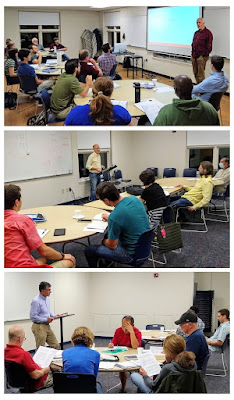
  Dear fellow students of God's word, Tomorrow evening, Lord willing, we plan to launch our first three classes of the Biblical Studies Institute of Blacksburg. Please plan to arrive a few minutes early , around 6:25 pm, at the side entrance of Blacksburg Christian Fellowship, 2300 N. Main Street. You'll be directed to the room where we will meet for a brief orientation. Soon afterwards we will split up into three classrooms. Tuition is not due the first night in order to let you experience the class before making a final decision. UPDATE: the Intro to NT Greek class is full and we cannot take any more students, sorry! Bible Study Methods and Hermeneutics, and Intro to Biblical Hebrew both have some open spots. We have decided that the Introduction to Theology will be offered in the spring. We are very thankful for the good response from our community! We're looking forward to seeing you tomorrow. Warmly in Christ Sandy Young Image credit: photo above by Green Chameleon on...

Why study the biblical languages?

Image
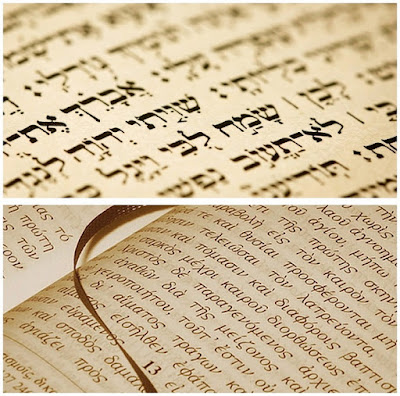
The two main languages in which the books of the Bible were originally written were ancient Hebrew and Koine (Common) Greek. Our English versions today are translations from these original texts. Learning these languages is not required for knowing and walking with the Lord, but there are several advantages to taking up their study. But there are two important caveats which I should mention. First, knowing Greek or Hebrew will not answer all your questions about the Bible. Many difficulties we face in studying the Scriptures are resolved on other levels, such as biblical theology, or the wider context of other passages. This is referred to as the analogy of Scripture, whereby other passages give us light on the more difficult ones.   Secondly, proficiency in the ancient languages will take time and discipline. This is true of gaining expertise in any language. We should beware of wanting to say, "the Greek means this," when we don't actually have that proficiency. We wou...

Why study hermeneutics?

Image
  Though the Bible was written for us , it was not written directly to us . What that means is, we study the Bible as readers once removed from the original audience. We must first understand what it meant to the original hearers (to whom it was written) before we can apply it to ourselves. Each book of the Bible has dual authorship -- the human author who wrote a message at a particular time and place, and the divine Author, God, who gives a message for all times and places.  When we read God's word we will be faced with questions like, what does this word or phrase mean? Is it literal or a figure of speech? Is this practice a cultural thing or meant to be universal? Is this teaching only for then, or for all time? The principles of interpretation, called hermeneutics , help us know how to correctly understand and apply the Scriptures. We want to know what it meant to the people at that time, what it means for all time, and from that, what it means for us today. Jim Krouscas ...

Why study theology?

Image
There is a popular misconception that the study of Christian theology is a heady and fruitless venture, reserved only for academics and wannabe theologians. But "theology" merely means the study (or knowledge) of God and of what he has revealed to us in the Scriptures. And it's in this sense that R. C. Sproul says, "Everyone's a theologian." We may be muddled about what we believe, but everybody believes something about God . The Bible speaks of having sound doctrine (Titus 1:9; 2:1) and of rightly handling the word of truth (2 Timothy 2:15). Connecting the truths of Scripture into a whole is what we call systematic theology .    Knowing God, therefore, involves first and foremost the use of our minds. It does not end with our thinking correctly, for truth must also be embraced, loved, and acted upon. But it must first be understood as clearly as possible. Many Christians feel it a waste of time to study theology, and so they rush ahead to feel and act upon...

Coming this fall

Image
We are pleased to announce the beginning of a Biblical Studies Institute in Blacksburg, this September, 2021.   Our goal is to provide in-person ( and locally-sourced ) courses for those seeking college level classes in Systematic Theology, Biblical studies, and introductions to the Biblical languages. In the spring we hope to add Church History. Classes will be open to residents in the New River Valley, and will be held at Blacksburg Christian Fellowship, 2300 N. Main Street, Blacksburg. The tuition is modest and will go mainly to defray the cost of building use. Who are we? We are a local group of men with pastoral, missionary, and educational experience who have a heart to see Christians, and their churches, grow in biblical and theological depth. As for myself, I am a semi-retired minister with 35 years of pastoral experience (and a bit more time on my hands). I’ve taught adult classes and served as a mentor for seminary interns, as well as tutoring young men in...