Christian apologetics is the study of the philosophy and method of defending the Christian faith. Since taking apologetics courses in seminary, and over 35 years of pastoral ministry, I have found these books to be the most helpful to me. Admittedly, they range from presuppositional to evidential in their approach -- but I have discovered that God freely uses a variety of means in bringing people to himself. Blomberg, Craig L. The Historical Reliability of the Gospels (IVP Academic, 2007). This is a very good, scholarly overview on that topic. Geisler, Norman L., and Turek, Frank. I Don't Have Enough Faith to Be an Atheist (Crossway, 2004). An excellent walk-through of the evidences for, and reasons why, we believe. Groothuis, Douglas. Christian Apologetics: A Comprehensive Case for Biblical Faith (IVP Academic, 2011). This is a larger reference work, and very worthwhile to have; it covers many of the issues and topics related to a...
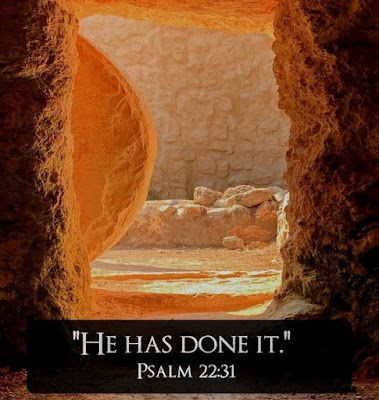
This week -- our last week of classes for spring semester -- let me offer this brief reflection on the death and resurrection of our Lord Jesus, taken from Psalm 22, which was written a thousand years before Christ died upon the cross. THE SUFFERING KING (Ps 22). A thousand years after David wrote this psalm of lament, his royal descendant, Jesus, spoke the first verse of it while he hung upon the Roman cross. Of course, that doesn't mean only that one verse, but rather the whole of the psalm, is about him. The suffering of the Messiah is plainly set forth, as it is also in Isaiah 53. David describes in detail what happened at the cross of Christ. At first reading of this psalm, we observe that David seems to be describing a rejection of his own kingship, and that is likely the context of its writing. But then we notice things that never happened to David... the dividing of clothing by lots, the pierced hands and feet, and the physical condition of his parched thirst, his b...
“But when the Helper comes, whom I will send to you from the Father, the Spirit of truth, who proceeds from the Father, he will bear witness about me. And you also will bear witness, because you have been with me from the beginning." (John 15:26-27) We are called to be witnesses for Christ (Acts 1:8). Yet sometimes we may feel outnumbered and alone in giving our witness. Our witness is our testimony of how and why we have come to trust the Lord Jesus. It's telling about what we know to be true and our experience of it. We may feel opposition from our hostile culture and be intimidated. Yet we need to remember our testimony, our witness, is one among many that confronts and weighs upon unbelievers . Who are these fellow witnesses? There are seven "testimonies" to the reality of God, his power, and his grace given to us in Jesus Christ. 1) The witness of creation (Psalm 19:1-2; Acts 14:7; Romans 1:20). People may suppress this knowledge, but there is...



Comments
Post a Comment